Walk into a period home and you tend to notice the floor first. Victorian style floor tiles catch the eye immediately and stay in your memory long after you leave. The colours, the patterns, the designs, they sit comfortably within the space and feel part of the home rather than decoration on top of it. They help to tell its story.
What makes these tiles so distinctive is not just how they look, but how naturally they belong. In Victorian homes, flooring was never an afterthought. Hallways, entrances, and transitional spaces were designed to make an impression, guiding visitors through the home while standing up to daily wear. Victorian style floor tiles achieved both, combining visual detail with practicality in a way that still feels relevant today.
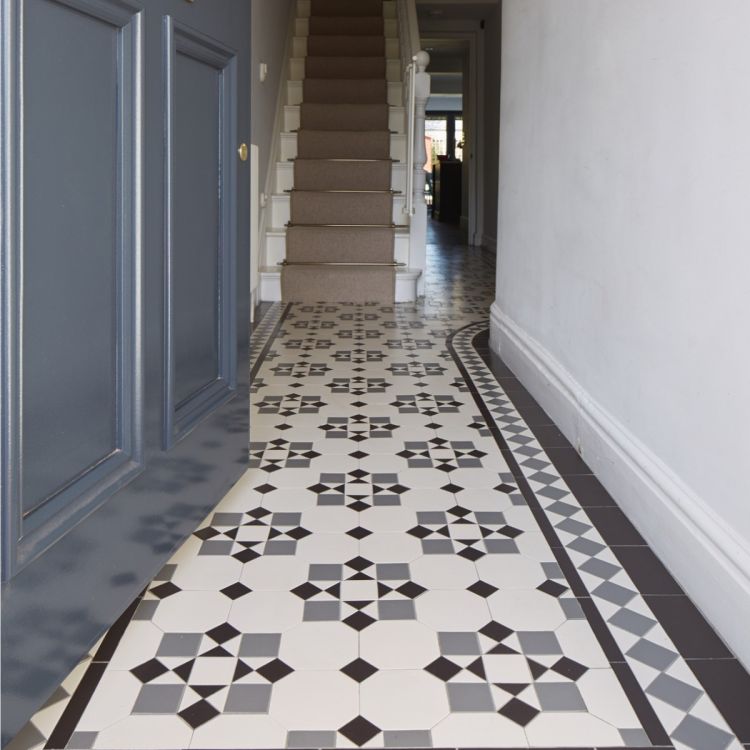
Victorian floor tiles stand out because they’re built from many small pieces arranged into precise geometric patterns. Instead of a single printed design, the “pattern” is the layout itself, often framed by a border to suit narrow halls and uneven walls.
They also feel authentic in period homes because the scale, colours, and structured repetition match Victorian proportions and detailing. That combination of visual order and hard-wearing practicality is what gives them their distinctive character.
What are Victorian Floor Tiles?
Victorian floor tiles are small-format tiles traditionally used in British homes built during the Victorian era, most commonly in hallways, porches, kitchens, and entrances. They are best known for their geometric patterns, rich but muted colours, and detailed layouts made up of many individual pieces rather than large single tiles.
Historically, these tiles were made from coloured clay rather than being glazed, which meant the colour ran all the way through the tile. This made them hard-wearing and practical for high-traffic areas, while still allowing for decorative patterns that reflected the design tastes of the time.
Today, Victorian style floor tiles are modern reproductions of those original designs. They are carefully remade to mirror the proportions, colours, and layouts found in period homes, but manufactured using modern techniques to ensure consistency, durability, and suitability for contemporary living. When laid correctly, they recreate the look and feel of traditional Victorian floors without the limitations that come with sourcing original tiles.
Because of this balance between appearance and practicality, Victorian style floor tiles remain a popular choice for restoring period properties or adding period character to homes with traditional architectural features.
Victorian floor tiles are small-format tiles used in 19th-century British homes, especially in hallways, porches, kitchens, and entrances. They’re best known for geometric, repeatable patterns made from lots of individual pieces rather than one large tile.
Traditionally they were coloured through-body clay tiles (not just surface-decorated), which helped them handle heavy foot traffic. Modern “Victorian style” tiles aim to replicate the same proportions, colours, and layouts with more consistent manufacturing.
Why Do Victorian Style Floor Tiles Suit Period Homes?
Victorian style floor tiles aren’t just decorative, their look and construction are deeply rooted in the architectural and cultural context of 19th-century homes, which is why they feel so right in period properties today. Here’s what makes them such a natural fit:
Reflect Original Design of the Era
The Victorian period was a time of eclectic design and ornamental interiors. Homes were built with a mix of influences, Gothic revival, classical motifs, and bold geometric detail, and interior finishes matched that mindset. Victorian style floor tiles, with their ordered patterns and balanced geometry, echo that visual language, so they complement period features rather than clash with them.
Pattern and Colours are Architectural Story Telling
In Victorian houses, floors weren’t blank functional surfaces; they were part of the décor. Tiles were used to introduce pattern and colour into entryways and hallways, spaces that would be seen first by visitors. The visual rhythm of repeated shapes and contrasting tones helped guide the eye and articulate space in a way that mirrors the design practices of the time.
Designed for the Way People Live
Original Victorian tiles were durable and low-maintenance, qualities that made them popular in high-traffic areas like porches and hallways. Their practicality was part of their appeal in period homes, and it’s still a benefit today. Reproductions retain that sense of robustness while offering contemporary manufacturing consistency.
Work for Traditional and Restored Settings
Whether you’re restoring a listed Victorian hall or updating a period kitchen, these tiles help bridge old and new. Their historical reference gives a sense of continuity, but because they’re available as modern reproductions, they avoid the issues (fragility, colour fading, scarcity) that come with original antique tiles.
The Practical Reasons Victorian Floor Tiles Were Used
Victorian floor tiles were chosen for far more than decoration. In the 19th century, homes needed hard-working materials that could cope with daily life, changing weather, and constant foot traffic. These tiles solved very real problems, which is why they became so widely used in entrances, hallways, porches, and kitchens.
One of the main reasons was durability. Original Victorian tiles were made from dense, coloured clay, fired at high temperatures. This made them exceptionally hard-wearing and resistant to wear over time. In busy households, where muddy boots, coal dust, and frequent visitors were the norm, floors needed to stand up to repeated use without showing damage quickly.
They were also practical from a maintenance point of view. Unglazed clay tiles did not show scratches or surface wear in the same way polished stone or timber floors could. Dirt was easier to sweep away, and the patterned layouts helped disguise everyday marks, scuffs, and dust, particularly useful in entrance spaces where cleanliness was harder to maintain.
Moisture resistance played a role too. Victorian homes often lacked modern insulation or damp protection, especially in porches and ground-floor hallways. Tiled floors coped far better with moisture than wood, which could swell, rot, or warp. Tiles provided a stable surface that handled damp shoes, umbrellas, and temperature changes without issue.
Another practical advantage was repairability. Because Victorian floors were made up of many small tiles, damaged sections could be lifted and replaced individually without disturbing the entire floor. This modular approach made long-term upkeep more manageable, a benefit that still applies with modern reproductions today.
These same practical reasons explain why Victorian style floor tiles remain popular in period homes now. While modern reproductions are manufactured differently, they still offer durability, ease of maintenance, and suitability for high-traffic areas, all while preserving the character that feels so natural in older properties.
Why were Victorian tiled floors so common in entrances? They solved everyday problems: they were tough under constant foot traffic, easy to sweep, and the busy pattern helped hide scuffs and tracked-in dirt.
Because the floor is made from many small tiles, damaged areas can often be repaired by replacing only the affected section. That “modular” layout is one reason Victorian-style floors still make sense in busy hallways today.
Pattern, Layout and How They Guide Movement Through the Home
Victorian style floor tiles were not laid at random. The patterns and layouts were carefully considered because entrance halls and corridors were transitional spaces, designed to move people through the home in an ordered way. The repetition of geometric shapes created a visual rhythm underfoot, which naturally draws the eye forward and makes movement through narrow or elongated spaces feel more fluid.
In hallways especially, the alignment of the pattern mattered. Designs were often laid to run lengthways with the space, visually stretching the hall and reinforcing its purpose as a route rather than a room to linger in. Even simple checkerboard or tessellated patterns helped establish direction, subtly guiding visitors from the front door towards staircases or adjoining rooms without the space feeling cluttered or confused.
Borders played an equally important role. Rather than being purely decorative, they acted as a visual frame that contained the main pattern and tied it to the shape of the room. This helped prevent the floor from feeling unfinished at the edges and gave the layout a sense of structure, particularly in irregular or narrow spaces common in Victorian houses. Borders also helped define thresholds, making it clear where one area ended and another began.
The scale of the tiles themselves contributed to this sense of order. Smaller tiles allowed for detailed layouts that worked in proportion with the finer architectural features found in period homes, such as narrow doorways, stair spindles, and decorative plasterwork. Larger modern tiles can feel overpowering in these settings, whereas traditional-style patterns sit comfortably within the existing proportions of the building.
The Role of Borders and Colour in Victorian Style Floor Tile Design
Borders were used to give Victorian tiled floors a clear edge. In period homes, walls were rarely perfectly straight, and hallways were often narrow or uneven. A border helped contain the pattern so it finished cleanly at the edges, rather than looking cut off or misaligned. It also made the layout feel deliberate, particularly in entrance halls where the floor was one of the first things you saw.
Borders also helped control the pattern. Without one, repeating designs could feel busy or unbalanced, especially in smaller spaces. The border created separation between the main pattern and the surrounding walls, which made the floor easier to read visually and stopped it from overwhelming the space.
Colour choices were practical as much as decorative. Victorian floor tiles commonly used darker shades around the edges and lighter tones within the main pattern. This helped hide dirt in high-traffic areas while keeping the centre of the floor from feeling too dark, particularly in halls with limited natural light.
The colours themselves were chosen to work together rather than stand out individually. Strong contrasts were used carefully, and most schemes relied on a small number of tones repeated across the layout. This kept the floor looking consistent and prevented the pattern from becoming tiring over time.
How Victorian Style Floor Tiles Differ From Modern Patterned Tiles
The main difference between Victorian style floor tiles and modern patterned tiles lies in how they are designed to sit within a space. Victorian style floor tiles were created to work with the proportions and layouts of period homes, particularly hallways, entrances, and transitional areas. Their patterns are structured, repetitive, and contained, which helps them feel settled and appropriate in buildings with detailed architecture and narrower floor plans.
Modern patterned tiles are usually designed as single, repeating surface designs printed onto larger formats. They are often intended to be visually striking on their own, rather than part of a carefully planned layout. In period homes, this can sometimes make the floor feel dominant, drawing attention to itself rather than working with the rest of the space.
Victorian-style floors are built up from many individual tiles. This allows patterns, borders, and colour changes to be adjusted to suit the exact shape of the room. Doorways, corners, and uneven walls can be accommodated without the design feeling forced. Modern patterned tiles are more limited in this respect, as the pattern is fixed within each tile and cannot be easily adapted without cutting into the design.
There is also a difference in longevity of appearance. Victorian layouts rely on colour running through the tile and patterns formed by arrangement rather than surface print. This means wear is less noticeable over time, which is one of the reasons original floors have survived for so long. Modern patterned tiles often rely on surface decoration, which can show wear more quickly in busy areas such as hallways.
If you’re choosing Victorian style floor tiles for a period home, start with the space: narrow hallways usually suit structured, repeatable geometry and a border that “finishes” neatly at the edges. The border can also help handle slightly uneven walls and awkward corners.
Next, keep the colour scheme disciplined. Using a small set of tones repeated across the layout typically looks more authentic than lots of competing colours, and darker edge colours can be more forgiving in high-traffic entrances.
If you are restoring a period property or looking to introduce traditional detail in a way that feels authentic, choosing the right Victorian style floor tiles matters. Tiles Ahead offers a carefully curated range of Victorian style floor tiles designed to reflect traditional layouts, colours, and proportions, while being newly made for modern homes. Explore the collection to find patterns and borders that suit your space and bring lasting character back into your home.
FAQ
Q: What are Victorian floor tiles made from?
A: Traditionally, they were dense coloured clay tiles with colour running through the body. Modern reproductions use modern manufacturing to recreate the look and durability.
Q: Where were Victorian floor tiles most commonly used in period homes?
A: They were often laid in entrance halls, porches, hallways, kitchens, and other high-traffic threshold areas.
Q: Why do Victorian tile patterns look so detailed?
A: The designs are built from many small tiles arranged into geometric layouts, often with borders and feature details rather than a single printed surface pattern.
Q: Do Victorian style floor tiles work in narrow hallways?
A: Yes. The small tile format and lengthways pattern alignment can visually guide movement and make long halls feel more ordered.
Q: What does a border do in a Victorian tile layout?
A: A border frames the main pattern, helps the design finish cleanly at edges, and can define thresholds between spaces.
Q: Why do Victorian tile colour schemes often use darker edges?
A: Darker tones around the perimeter can help disguise dirt and scuffs in busy entry areas while keeping the centre lighter.
Q: How do Victorian style tiles differ from modern patterned tiles?
A: Victorian-style floors are made from individual tiles arranged into a layout, so borders and pattern changes can be adapted to the room. Many modern patterned tiles rely on a fixed printed design on larger formats.
Q: Are Victorian tiled floors repairable if a section gets damaged?
A: Often, yes. Because the floor is modular, individual tiles or small sections can be lifted and replaced without redoing the whole floor.